
In recent years, interest in traditional Japanese kitchen tools has grown steadily among professional chefs and dedicated home cooks. Within this category, the Nakiri knife stands out as one of the most purpose-driven blades ever created. While many knives are designed for versatility, the Nakiri concentrates on one task and refines it to a high level: preparing vegetables with speed, precision, and consistency.
Among Japanese knives, the Nakiri holds a clearly defined role. Its design reflects centuries of development centered entirely around vegetable preparation, making it a specialized tool with practical advantages in the modern kitchen.
What a Nakiri Knife Is
Nakiri (菜切り包丁) literally translates to “vegetable cutter” in Japanese. It is a traditional Japanese kitchen knife developed specifically for preparing vegetables. Every element of its form supports straight-down slicing rather than broader tasks such as meat butchery.
Unlike general-purpose blades, the Nakiri follows a focused principle: efficient vegetable processing. From cabbage and carrots to herbs and onions, it is engineered to produce clean, repeatable cuts with minimal effort.
Blade Shape and Geometry
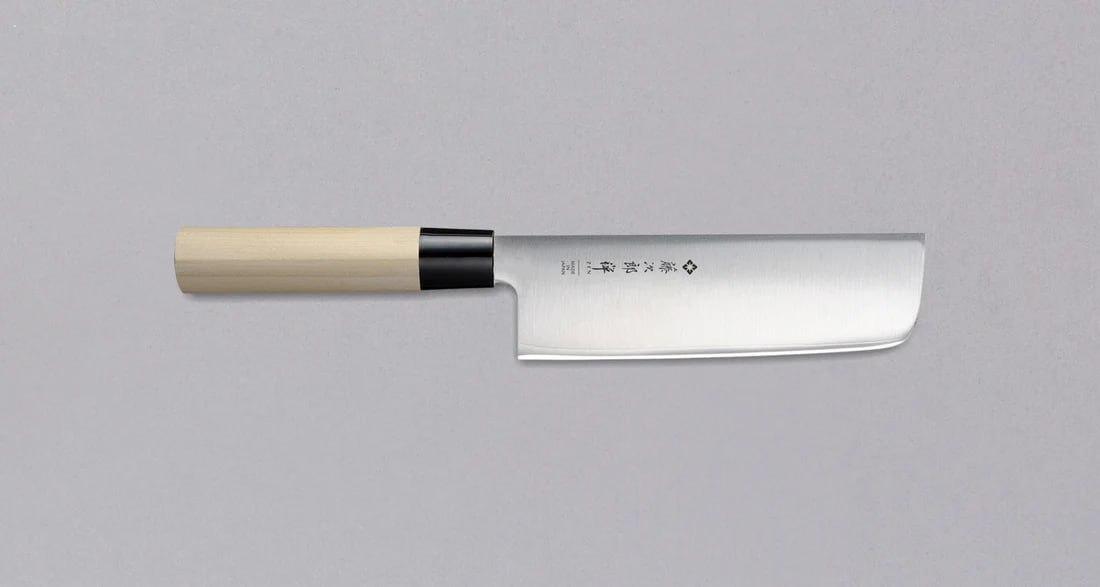
The defining characteristic of the Nakiri knife is its blade shape. The cutting edge is completely straight from heel to tip, unlike curved chef’s knives. Because of this flat edge, the entire blade makes contact with the cutting board at once.
The blade profile is rectangular, with a blunt or squared-off tip. This shape is intentional. It maximizes usable edge length and supports clean, vertical cutting motions.
The blade geometry is also notably thin. That thinness reduces resistance as the knife moves through vegetables, allowing it to glide smoothly instead of forcing its way through. Together, the straight edge and thin profile ensure that every millimeter of the blade works simultaneously, producing clean and even slices.
What Sets It Apart from Other Knives
Vegetable-Focused Design
Nakiri knives are not general-purpose tools. They are optimized solely for vegetables—slicing, dicing, chopping, and shredding. Because the edge is completely flat, the user can cut all the way to the board without leaving partially attached strands.
This differs from blades such as the gyuto, which functions as a general chef’s knife with a curved edge suited to multiple tasks, or the santoku, which offers an all-purpose design with a slight curve. The Nakiri remains dedicated to vegetable preparation and does not attempt to replace multi-tasking blades.
Straight Cutting Motion
Instead of the rocking motion commonly associated with Western chef’s knives, the Nakiri is used with vertical push-and-pull cuts. The blade travels straight down into the ingredient and lifts in a controlled movement.
This method improves efficiency, especially when processing larger quantities of produce. It also promotes consistent slice thickness, which matters in professional kitchens where uniformity affects presentation and cooking time.
Blade Thinness and Precision
The thin cutting edge moves through produce with minimal crushing. Delicate ingredients such as tomatoes, herbs, or leafy greens retain their structure instead of bruising under pressure.
Uniform slices contribute to even cooking. When thickness remains consistent, heat distribution becomes more predictable, which supports balanced texture and flavor in the final dish.
Light and Balanced Handling
Nakiri knives are typically lighter and balanced slightly toward the blade. This distribution supports repetitive cutting without unnecessary wrist strain.
Their relatively compact size and low weight make them practical for extended preparation sessions. In professional environments where prep work can last hours, this ergonomic advantage becomes significant.
Versus Other Japanese Knives
When compared with other Japanese knives, the distinctions are clear:
- Gyuto: A general chef’s knife with a curved edge designed for varied tasks. The Nakiri is more specialized and fully flat.
- Santoku: An all-purpose Japanese blade with a slight curve. The Nakiri maintains a straight edge from heel to tip.
- Usuba: A professional single-bevel vegetable knife offering extreme precision but requiring advanced skill. The double-beveled Nakiri is more accessible for most cooks.
Those exploring high-quality Japanese knives often encounter curated selections such as the Japanese knives offered by SharpEdgeShop, where vegetable specialists sit alongside versatile models.
For readers considering similar rectangular designs, the Bunka knife represents another Japanese profile with a different tip geometry and broader application. In contrast, detailed resources on the Nakiri knife emphasize its dedicated role in vegetable preparation.
Practical Impact in the Kitchen
The Nakiri’s construction translates directly into practical benefits.
Preparation often becomes faster because vegetables can be processed quickly and with consistent thickness. The straight edge reduces incomplete cuts and minimizes corrective strokes.
Results appear cleaner. The combination of a thin blade and flat edge produces defined edges and even slices.
Effort decreases as well. The straightforward up-and-down motion simplifies technique and limits unnecessary wrist movement.
Texture improves. Vegetables maintain better cell integrity, cook evenly, and retain a crisp structure.
Limitations to Know
Despite its advantages, the Nakiri is not intended to replace every knife in the kitchen.
It is not suited for heavy-duty tasks such as cutting through bones or splitting very hard squash. Because the blade is thin, twisting or prying motions should be avoided.
It is also less versatile than a traditional chef’s knife. While it excels at vegetable preparation, it is not designed to function as a single do-everything tool.
The Philosophy Behind the Blade
A knife remains the most fundamental tool in the kitchen. The correct size and type, appropriate steel, a well-designed handle, and precise sharpness transform it into an extension of the arm.
Japanese chefs often describe this harmony as Jinba Ittai 人馬一体, meaning “person and horse as one body.” In culinary terms, it represents a seamless connection between cook and blade. When the tool responds naturally to movement, attention can remain fully on the ingredient.
SharpEdgeShop presents itself as a destination for high-performance blades. The company emphasizes education for food enthusiasts and professional chefs, focusing on the importance of a sharp kitchen knife and its impact on preparation and flavor. By guiding users through blade types, steel characteristics, and maintenance principles, SharpEdgeShop supports a deeper understanding of the tools used in daily cooking.
The objective remains consistent: encourage every cook to achieve their own version of Jinba Ittai. With a purpose-built blade such as the Nakiri, the relationship between technique and ingredient becomes precise, efficient, and intentional.